
Behind the Screen - A Blog
How Much Does a Website Cost in the UK? (2026 Honest Guide)
How Much Does a Website Cost in 2026? A Web Designer's Honest Answer
Updated May 2026 · 9 min read
The short version: A professionally built website in the UK costs anywhere from £500 to £15,000 or more, depending on what your business actually needs. This post breaks that down into plain numbers so you can work out what applies to you, without the sales pitch.
I get asked this question more than any other. Sometimes it comes from a new business owner who has never had a website before. Sometimes it comes from someone who had one built five years ago and cannot believe what they were quoted this time around.
The honest answer is that website costs vary enormously, and most of the guides you will find online are written by agencies whose pricing starts at £5,000. That does not help a bakery owner in the Wirral, a pub in Edinburgh, or a financial services firm in London who wants a straight answer about what a decent site actually costs.
So here is the real picture, based on 25 years of building websites for businesses right across the UK.
Why Website Prices Vary So Much
Before the numbers, it is worth understanding what you are actually paying for. A website is not a single product. It is more like a building: the cost depends on how big it is, what it needs to do, who builds it, and how it is maintained afterwards.
The main factors that affect price are:
Who builds it. A large digital agency in a city centre has high overheads and will price accordingly. A freelancer working remotely does not. Neither is automatically better; they are just different services. For most small and medium-sized businesses, a freelancer with a strong portfolio often gives you better value and more direct communication than an agency where you never speak to the person actually doing the work.
How many pages it needs? A five-page brochure site for a sole trader is a fundamentally different project to a 200-product WooCommerce store. More pages mean more time, and time is what you are paying for.
What it needs to do. A contact form is straightforward. A booking system with calendar integration is not. Online payments, membership areas, subscription products, live stock management: each one adds complexity and therefore cost.
Whether it is built from a template or from scratch. A template-based build using a theme like Divi or Elementor is faster than building a bespoke theme from the ground up. Both can look professional. The difference is flexibility and how much it can be tailored to your exact brand and requirements.
Ongoing support. This is where many businesses get caught out. The build price is a one-off cost. Hosting, domain renewal, security, software updates, and someone to call when something breaks are recurring costs. They are not optional if you want the site to keep working properly.
The Four Types of Websites and What They Cost
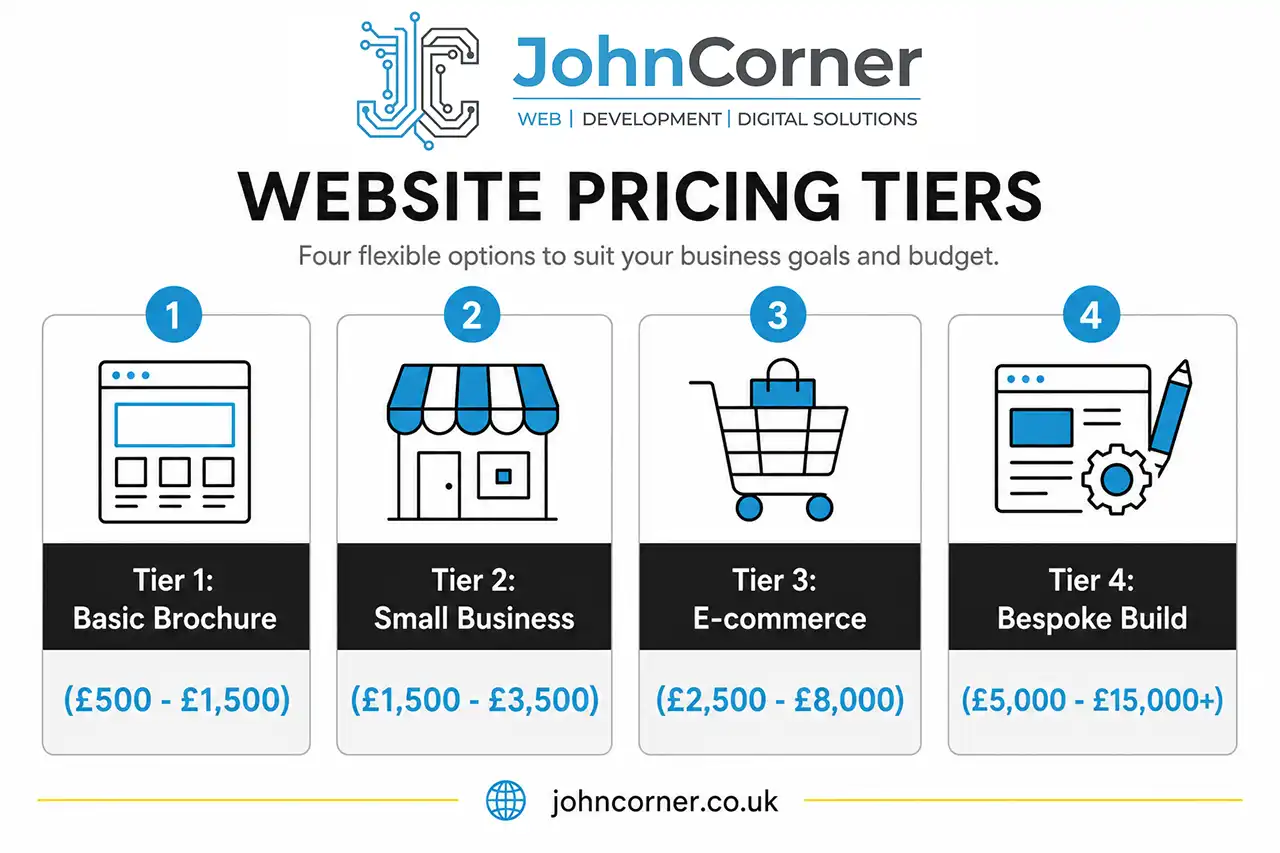
1. Basic Brochure Website: £500 to £1500
This is a simple, professional online presence. Typically five to eight pages: Home, About, Services, Gallery or Portfolio, and Contact. It tells people who you are, what you do, and how to get in touch.
Who it suits: Sole traders, tradespeople, small local service businesses. A driving instructor, a dog groomer, a personal trainer. Someone who needs to be found online and make a good first impression, but does not need complex functionality.
What you get: A mobile-friendly, professionally designed site built on WordPress. A contact form. Basic on-page SEO so Google can find it. A site you can update yourself once it is live.
What you do not get: Custom design from scratch, e-commerce, booking systems, or any significant ongoing work beyond initial setup.
Typical timeline: Two to four weeks from brief to launch, assuming content (text and photos) is provided by the client.
The honest caveat: At the lower end of this range, some providers use very basic templates with minimal customisation. There is nothing wrong with that for a very simple need, but if your business depends on the site bringing in work, it is worth spending a little more to get something that actually looks and performs like a professional operation.
2. Small Business Website with Enquiry Features: £1,500 to £3,500
This is the most common type of site I build. It goes beyond a basic brochure: more pages, stronger design, and features that help turn visitors into enquiries.
Who it suits: Established small businesses that want to compete properly online. A bar or restaurant that needs to look the part and take bookings. A professional services firm that needs to build trust quickly. A trades business that wants to show its work and generate quote requests.
What you get: A professionally designed WordPress site, usually ten to twenty pages. Better photography integration. More advanced SEO setup. A contact form with multiple enquiry types. Sometimes, a simple booking or quote request form. Google Analytics and Search Console are connected, so you can see how the site is performing. A handover session, so you know how to make basic updates yourself.
What you do not get: Online payment processing, full e-commerce functionality, or custom web applications.
Typical timeline: Four to six weeks, depending on complexity and how quickly content is supplied.
Real example: I built the website for a well-established pub and kitchen in Edinburgh. The brief was straightforward: look credible, communicate the atmosphere, and make it easy for people to book a table or find out about events. The site sits comfortably in this price bracket. It is clean, fast, and does exactly what a hospitality business needs its website to do. Since launch, the client has had no shortage of organic traffic from people searching for dining and drinks in the city.
3. E-commerce Website: £2,500 to £8,000
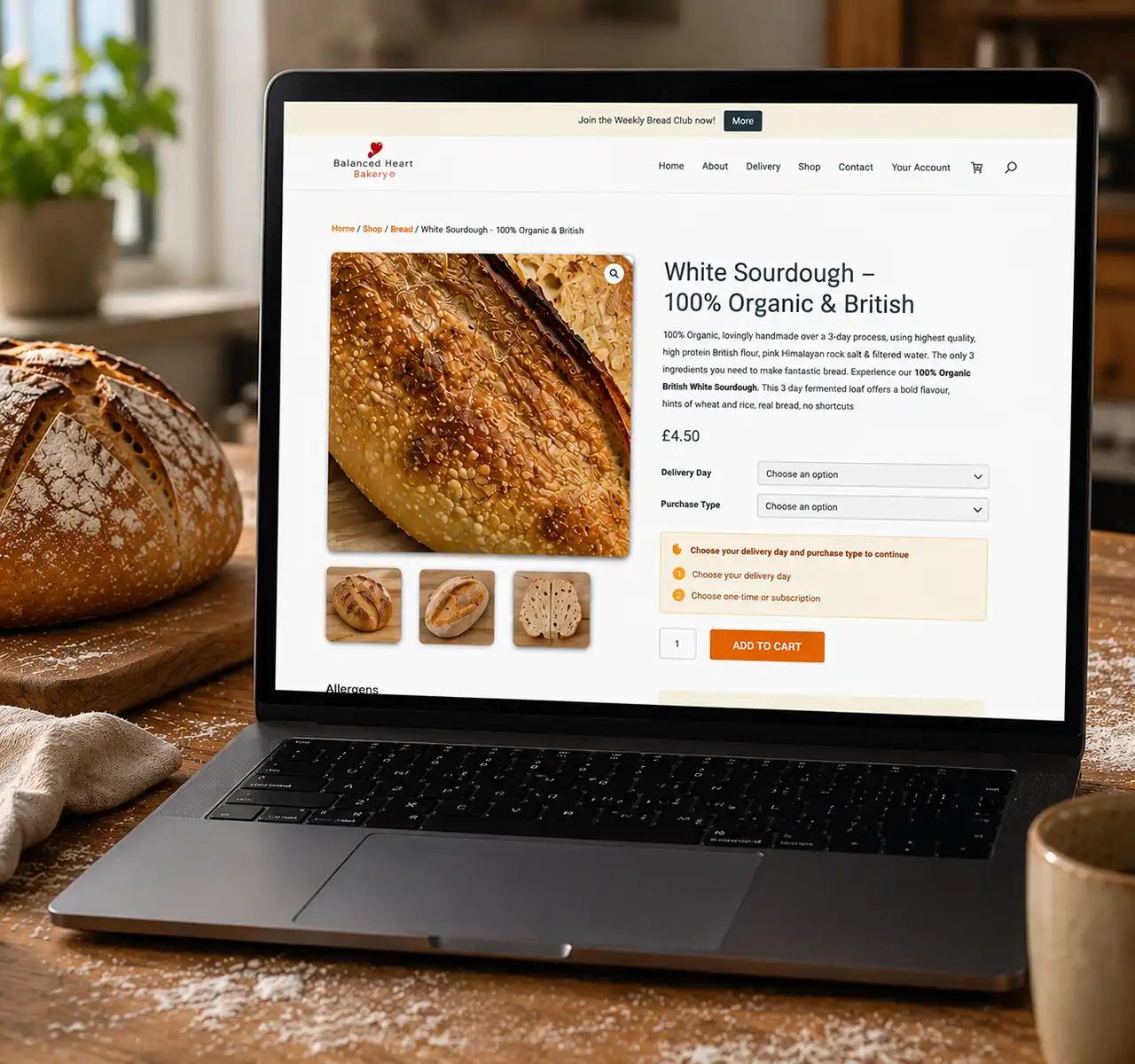
Once you introduce online selling, the project gets significantly more involved. Payment processing, product pages, stock management, delivery options, VAT handling, order confirmation emails, customer accounts: every one of those needs to be built, tested, and set up correctly.
Who it suits: Any business selling products or services online. A food producer selling directly to customers. A retailer. A business selling subscriptions or digital products.
What you get: A WooCommerce store built on WordPress, which gives you full ownership and control over your shop without paying a monthly fee to a third-party platform like Shopify. Product pages set up and configured. Payment gateway integration (Stripe or PayPal). Delivery zone setup. Basic SEO for product and category pages. Testing across devices and browsers before launch.
What you do not get at the lower end: Large product catalogues already populated (that is usually charged as additional time), complex custom checkout flows, or advanced integrations like stock syncing with a warehouse system.
Typical timeline: Six to twelve weeks for a standard store. More complex builds take longer.
The Shopify question: I am often asked whether WooCommerce or Shopify is better. For most small businesses, WooCommerce built on WordPress gives you more control, no platform monthly fee, and full ownership of your data. Shopify is simpler to manage for very small catalogues, but the monthly cost adds up over time, and you are locked into their platform. The short version: if you want ownership and flexibility, WooCommerce. If you want simplicity above everything else and do not mind the ongoing fee, Shopify has its place. I will cover this in more detail in a separate post.
Real example: I built the e-commerce site for a bakery in the Wirral. What started as a standard online shop grew into something considerably more involved: trade ordering for wholesale customers, standing order management, subscription products, and custom delivery scheduling to handle their specific logistics. That sits at the more complex end of this price bracket, and reflects the time required to build and test custom functionality on top of a standard WooCommerce setup. It works well precisely because it was built around how that business actually operates, not how a generic e-commerce template assumes it does.
4. Bespoke or Larger Business Website: £5,000 to £15,000 and beyond
This covers larger sites with significant custom development: membership platforms, booking systems with complex logic, sites that integrate with third-party business software, multi-location businesses with different content per location, or organisations that need a site built to a precise specification.
Who it suits: Larger SMEs, growing businesses with specific technical requirements, and organisations that have outgrown a template-based approach.
What you get: Custom development work built to do exactly what your business needs, not adapted from a theme. More robust testing, more involved project management, and typically an ongoing support arrangement. You can see examples in my portfolio.
Real example: I worked with a financial services company in London that needed a site reflecting the credibility and professionalism their clients expect at that level. The brief included a polished design with no off-the-shelf feel, carefully structured content for a regulated industry, and an ongoing relationship covering updates and compliance changes. The build itself sat at the upper end of this bracket. When your business operates in a sector where trust is everything, the website has to earn that trust in the first few seconds. Cutting corners on a site like that is a false economy.
What to watch out for: At this level, the project management process matters as much as the technical skills. Make sure any quotes are broken down by deliverable, not just a single number. Understand what happens if the scope changes mid-project.
What Is Not Included in Those Prices
The build cost is one thing. There are other costs involved in running a website that every business owner should know about upfront.
Domain name: Usually £10 to £20 per year for a .co.uk or .com. You should own this yourself, registered in your name, not your developer's.
Hosting: A decent managed WordPress hosting plan costs £10 to £40 per month, depending on the level of support and performance you need. Cheap shared hosting at £1.99 per month is false economy for a business site; the performance and support are usually poor. I recommend fast, secure business hosting for business-critical sites, that's why I own and manage my own hosting server for lots of clients.
SSL certificate: Usually included with reputable hosting. Non-negotiable in 2026; a site without HTTPS shows a warning in browsers and is penalised in Google rankings.
Maintenance plan: This is optional but strongly recommended. A basic maintenance plan covering monthly updates, security monitoring, and backups typically costs £10 to £100 per month, depending on what is included. Without it, your site is a car you never service: it works until it does not.
Photography: This catches a lot of people out. Stock photos look like stock photos. If you want a site that represents your business properly, invest in a photographer. A half-day shoot typically costs £250 to £500, and the difference it makes to the finished site is significant.
Copywriting: Writing the content for your own site is harder than most people expect. If you want a professional to write your page copy, add £500 to £1,500 to the project budget, depending on how many pages need writing. Make sure its SEO friendly and fit for purpose!
The Questions to Ask Before You Agree to Anything
Whether you are approaching me or anyone else, these are the questions worth asking before you sign off on a project.
Who owns the website when it is finished? You should own everything: the domain, the hosting account, the WordPress install, and the theme. Some providers build your site on their own hosting platform and essentially rent it to you. If you leave, the site goes with them. Always insist on ownership.
What is included in aftercare? The first month after launch is when issues tend to surface. Is there a support period included? What happens if something breaks on day thirty-two?
Can I see examples of similar work? A portfolio is only useful if it includes projects similar to yours in scope and sector. A web designer who has built twenty hospitality websites and no e-commerce stores is not the right choice for a WooCommerce project, regardless of how good those restaurant sites look.
Do you do the work yourself, or outsource it? Some agencies quote a project and then hand it to a subcontractor abroad. There is nothing illegal about that, but you should know. With a freelancer, you are usually dealing directly with the person doing the work.
What do I need to provide, and when? Delays on website projects are overwhelmingly caused by waiting for content from the client: text, photographs, logo files, and brand guidelines. Know what you need to supply and when, and the project will move faster.
What Does a Bad Website Actually Cost You?
This is the question most people do not ask. The focus tends to be on keeping the upfront cost down. That is understandable, especially for a new business.
But a website that does not perform has a cost too. If your site looks amateur, potential customers go elsewhere. If it loads slowly, Google ranks it lower. If it is not mobile-friendly, you are invisible to the majority of people searching on their phones. If there is no clear call to action, visitors leave without getting in touch.
I have taken on projects from businesses that spent £300 on a site two years ago and have had no enquiries from it since. The conversation usually involves working out whether the issue is the site itself, the SEO, or both. Sometimes a rebuild is the answer. Sometimes a well-targeted set of improvements gets there without starting from scratch.
The right website for your business is not the cheapest one. It is the one that earns back what it costs in new business, ideally many times over.
So, What Should You Budget?
Here is a straightforward summary based on business type.
Sole trader or new small business: Budget £800 to £1,500 for a clean, professional brochure site. Do not go cheaper than this if you want something that will actually represent your business well and be found on Google.
Established small business: Budget £2,000 to £3,500 for a well-structured site with proper SEO setup, good design, and a clear enquiry journey.
E-commerce or online shop: Budget £3,000 as a realistic starting point for a basic WooCommerce store. More complex builds will cost more. Get a clear breakdown of what is included before agreeing to anything.
Ongoing running costs: Budget at least £50 to £80 per month for hosting and basic maintenance. Less than this and you are usually cutting corners somewhere.
FAQs
How long does a website last before it needs rebuilding?
A well-built WordPress site should serve you for four to six years before a full rebuild is needed, provided it is maintained and updated regularly. A refresh of the design can extend that further. A neglected site with outdated software and a theme that has not been updated is a security risk and may need replacing sooner.
Can I build my own website instead?
Yes. Platforms like Wix, Squarespace, and WordPress.com make it possible to build a basic site yourself. For a very new business with almost no budget, that can be a reasonable starting point. The limitations become apparent when you need to rank for competitive search terms, customise the design significantly, or add features the platform does not support. Most business owners also find that the time involved is more than they expected. (..and your time is better spent running your business!)
Should I pay a monthly fee or a one-off fee?
Both models exist. One-off builds where you own everything outright are generally better value in the long run. Monthly subscription website services, where you pay £50 to £150 per month for a site you never own, can look affordable but cost more over three to five years. Crunch the numbers over a five-year period before deciding.
What about those cheap websites I see advertised online?
Very cheap website services, typically £99 or £199, are usually template-based builds with minimal customisation, hosted on the provider's platform, and come with significant limitations. They can work for a very basic online presence. They rarely rank well in Google, and they do not give you ownership of anything.
Is SEO included in the website cost?
A good web developer will build your site with solid technical SEO foundations: clean code, fast loading, proper heading structure, meta titles and descriptions, Google Analytics and Search Console connected. That is different to ongoing SEO work, which is a separate service. If a developer promises to get you to page one of Google as part of the build cost, treat that claim with scepticism.
How do I know if I am getting a fair price?
Get two or three quotes and make sure they cover the same scope. A cheaper quote that does not include hosting setup, SEO configuration, or post-launch support is not a like-for-like comparison with one that does. Ask each person to walk you through what is included, line by line.
The Bottom Line
A decent website for a small or medium-sized UK business costs between £1,500 and £4,000 for most projects. That is not a guess; it is based on doing this for 25 years across hundreds of projects, from a bakery in the Wirral to a finance company in London.
Spend less than that, and you are usually compromising on something that will matter later: the design, the SEO, the functionality, or the support. Spend significantly more, and you need to be clear on exactly what that extra investment is buying.
If you want a straight conversation about what your specific project would cost, get in touch. No jargon, no inflated proposals, no hard sell. Just an honest answer based on what you actually need.
Working with businesses across the UK, from sole traders to growing SMEs. Get in touch, and I will give you a straight answer on what your website project would realistically cost.